
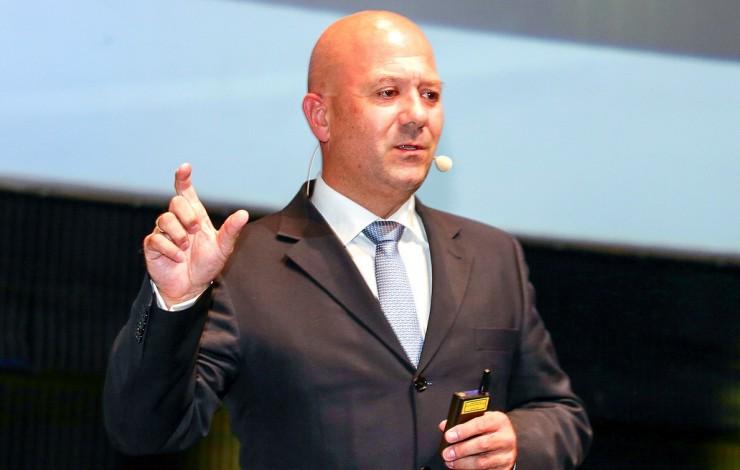
Upper Austrian Automotive Know-how at Top Events
Thomas Stottan and AUDIO MOBIL Elektronik GmbH, which he has headed as CEO for over 25 years, are inextricably linked in the automotive industry with visionary ideas and innovations concerning vehicle networking and operation. The domestic research and development company is a supplier to BMW, Daimler, Volkswagen, and Porsche, among others.
It is also due to the company’s innovative strength that Thomas Stottan is repeatedly invited as a speaker to top events, offering attendees a glimpse into the future of mobility.
AutoContact – the industry meeting of the Styrian Automotive Cluster – and the Salzburg Transport Days were the latest stops in September and October of this year. In vivid presentations, Stottan highlighted the challenges of future mobility models and the associated economic market potential, inspiring numerous participants with previously unknown approaches to CarICT.
Greatest Market Potential for IT Components in Vehicles
“Vehicle networking is a completely underestimated market segment in the automotive sector with above-average potential – here, it is crucial to help shape the future and contribute our collective expertise accordingly,” says Stottan.
Contrary to prevailing opinions about an economically rather struggling automotive industry, especially in connection with the current emissions scandal at Volkswagen, the development of the Europe-wide market for individualized vehicle networking can predict a market segment worth around 150 billion Euros or more for the industry. “For Austria alone, a sales volume of 20 billion Euros and more would result,” Stottan further explains.
Human-Machine Interfaces as a Solution for Modern Transportation
In connection with the boom sectors of vehicle networking and “autonomous driving,” intuitive vehicle operation must not be disregarded. As can be learned from the drivers of this autonomous locomotion, mostly the car manufacturers themselves, fully autonomous locomotion will still be many years away. In the meantime, clever solutions must be found for the long interim phase of partially autonomous mobility.
“Basically, modern vehicles have had systems for partially autonomous locomotion for quite some time. After all, sensors such as distance radar, lane assistants, etc., must be included in this thematic context. The key to the success of networked vehicles and autonomous locomotion will be highly intuitive and situationally adaptable HMIs (Human-Machine Interfaces) which, on the one hand, relieve us of the rudimentary tasks of driving, but on the other hand, also provide the safety to intervene directly in the driving process in an emergency. However, the explicit requirements of women and men also differ and must therefore be considered separately,” says Stottan regarding the numerous upcoming tasks for the automotive industry.
One can therefore be curious about what innovations vehicle drivers will be confronted with in the near future, as renowned IT giants are now also pushing into the previously clearly structured world of automobiles.

Leave a Reply
Want to join the discussion?Feel free to contribute!